Posts mit dem Label Cold War werden angezeigt. Alle Posts anzeigen

Montag, 10. August 2015

A different Museum of the Allies

I consider myself quite a knowledgeable person when it comes to every hidden museums of Berlin, but it seems that as in the case of many other issues, it is hard to keep up always with the changes. As usual, the more I walk in less known place, the more I learn about the city. No wonder then, almost one month ago, while doing research before the European Maccabi Games, I discovered the West Alliirte in Berlin Museum. It is a free private museum, hosted in a small house with a view over the tennis courts of the Stadium, open only on Wednesdays, Saturdays and Sundays or by request. 
For a rainy Sunday afternoon, the museum was quite full of visitors, from all over the world. Situated in what once used to be the British sector, it offers a variety of objects from the everyday life of the troops and the military stationed in this part of the city. Noteworthy, compared with the similar museum from Clayallee, it focuses more on the British and French sections. 
Do not expect surprising revelations or some information that may change dramatically your perception abou the post WWII times. The visitor will find a lot of basic documents - in the sense of the new history trends - about that times, from uniforms to issues of the French Gazette, warning signs and objects used in the daily life of the military. 
The space is not that big and the materials not necessarily punctilioulsy organised, but someone with already a basic knowledge about those times will have a better picture about the daily life on that part of the Curtain.
By using objects provided by private collections, various camp facilities were rebuilt.
A lot of documents and reconstructions are dedicated to the time of the blockade when, among others, Hershey's chocolates landed in Berlin, throwed up with white napkins as parashutes from the Allies airplanes. 
Walking the museum was an interesting applied lesson of history, always interesting, especially when it comes to facts that are still part of the everyday life. Sometimes, in order to understand complex things, you need to start by basic daily facts and this small museum has the potential to bring something different to its visitors. Cold War histories are still popular in Berlin.

Donnerstag, 15. September 2011

AlliiertenMuseum - Allied Museum - Musée des Alliés


All those passionate about WWII and Cold War should visit - for free - this museum situated in the middle of a quiet green residential area close to Krumme Lanke. The information displayed - in the yard and in the two separate sections - is available in German and English, you are offered movies documenting the daily life of the UK, French and American troops and the personnel speaks English. 

You can take pictures - without flash - or buy books about the West Berlin and the period following the end of the war. You need to spend here maximum two hours and at the end of the visit you'll conclude that it was an useful choice. 

The Hastings TG 503, produced since May 1946, the largest transport machine of the Royal Air Force, used during the Berlin Airlift


Checkpoint Charlie guardhouse - 1986-1990


The Strasbourg-Berlin French military trained, used till 1982

Memories of the Berlin Blockade


Douglas C-54 propeller


Remember the nuclear hysteria?

Berlin spy tunnel - A Reconstruction

French memories
A former outpost from the Wall


Enhanced by Zemanta

Mittwoch, 17. August 2011

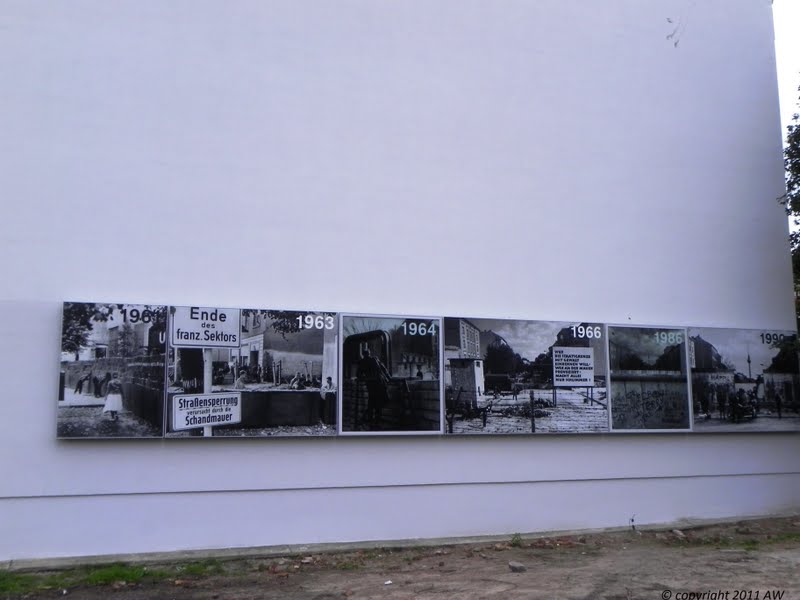
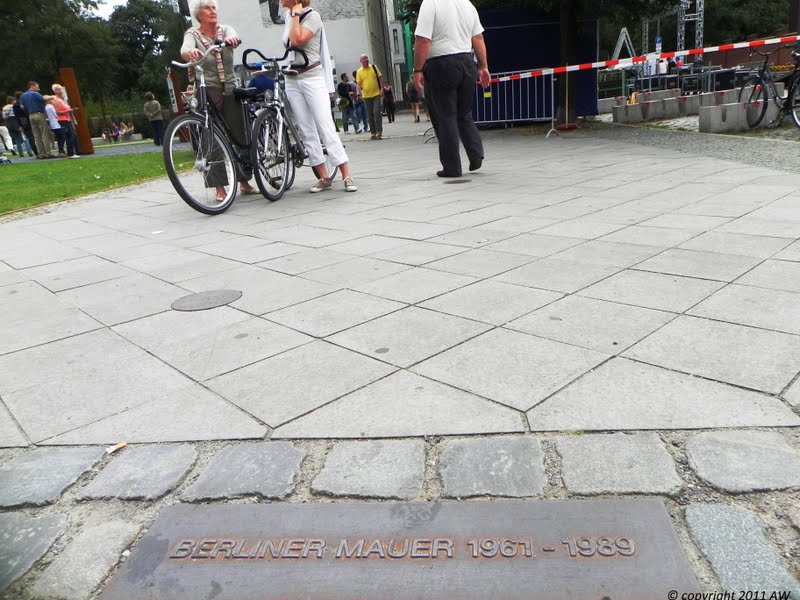
Memories of the wall-Bernauer Str.

50 years after, the Berlin Wall is part of the history of many Berliners and of Europe in general


Because the way in which the border was drawn in this area - the houses on the southern side of the street were in the Soviet sector, while the sidewalks in front of them belonged to the French sector


The Berlin wall heritage is one of the priorities of tourists visiting the city. Guides, websites and various group tours are focused on offering information about the Cold War history.

The jazz singer


Between 1961 and 1988, well over 100,000 citizens of the GDR tried to escape across the inner-German border or the Berlin Wall. Along the Berlin Wall alone, from 1961 to 1989 at least 136 people were killed or died in other ways directly connected to the GDR border regime.


Enhanced by Zemanta