Posts mit dem Label Jewish life Berlin werden angezeigt. Alle Posts anzeigen

Dienstag, 7. April 2015

Israeli lunch and unforgettable Pavlova at NENI

The 25 hours hotel bikini Berlin opened more than one year ago, and pleasant gossips about good food and interesting interior design reached my foodie ears, but although I am visiting the vicinity at least once the week, I did not dare to go further on from the hipsterish entrance. Till one day, when too tired after an early spring trip through Tierpark I went straight away, passed the Trabant in the lobby and went up to the 10th floor to NENI restaurant and its Monkey Bar. As usual, my spontaneous plans bring always the best results.
The elevator stopped directly to the 10th floor and for the beginning, made a tour of the Monkey Bar, with comfy sofas covered by colourful pillows outlined by mysterious lights in the corners. It is mid-day and the ambiance in the lounge is chilling, with some people eating from the plates resting on their knees, everything under the playful eyes of the monkeys on the metal plattered walls that reminds some old temples in Thailand.
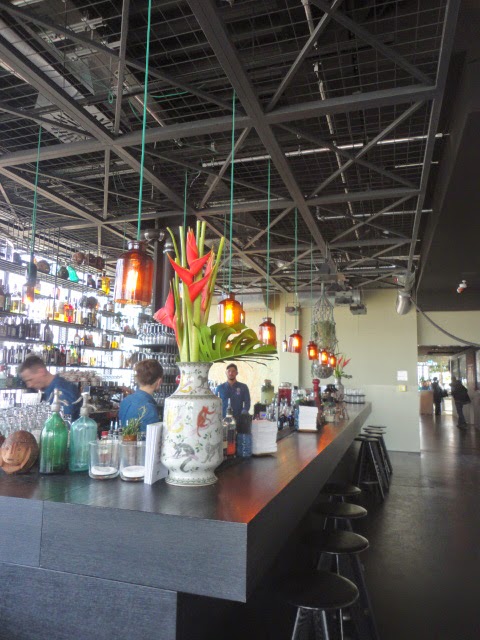
Similarly with the design of the neighbouring Bikini concept stores, the ceiling is an intricated plumbing labyrinth, but the flower decorations, and the bric-a-brac of vintage objects exposed on the massive counter brings a note of irony and home feeling to the huge space. 
Colours and the natural light are dotting the massive wooden blocks. Cocktails parties are often held here, under the motto of Balagan, the Yiddish word for overwhelming chaos - a leaflet at the bar describes it as a 'sympathetic chaos'. As the hunger won over my interest for design and etymology, I promise to think more about it when I will for some cocktails. 
It is one sunny day, so I stay a couple of more minutes on the terrace, admiring the view over Ku'damm and the KaDeWe. As everywhere around, there is a lot of green which makes the stay even more enjoyable. In a way, it reminds me of the nice green rooftops of Tel Aviv, always ready to welcome unknown guests for the long summer parties. 
But it is time for real food now, otherwise the brain cannot think. Not as fast as I wish, because there is a long cue and I have to wait in line to be seated. As usual, since living in Europe I forgot how important a reservation can be for a successful lunch, but luckily, there are some places left for the spontaneous type of humans. 
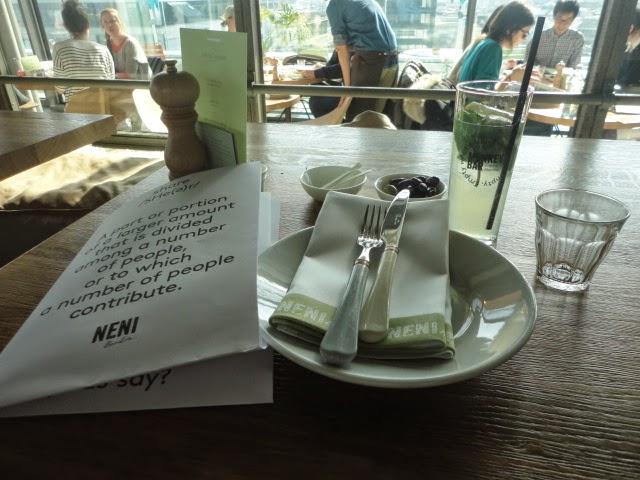
After being seated, my order is taken even faster, by one of the many people running around as organized bees. Despite the full tables and the Babel of languages, everything goes rapidly and you feel like home. You can even have a look at the kitchen, where home-made recipes are prepared. It seems that the idea of the founder of NENI, the successful Haya Molcho that moved from Vienna to Berlin, to make the restaurant more than an eating place, but a place you feel like home, was successful. NENI stands as the acronyme of the names of her four sons: Nuriel, Elior, Nadiv and Ilan. 
The menu is not that long, but has so many dear recipe names to me that I don't hesitate a second before ordering: a lemonade, prepared according to the highest standards of the Tel Aviv restaurants (the kind that I am longing for for centuries in this city), cold, with mint leaves and balanced portions of sugar and lemon; sabich; and...some special sweet non-existent in Berlin till now whose name I will disclose later on. While waiting, some fresh olives covered in spices and olive oil make me dream about sea and the summer.
The place looks like a huge eatery, with a podium in the middle with more tables, under a coverage of green plants hanging from the ceiling. Tables are also set outside, where one can admire some fancy parts of West Berlin while eating. 
The pita is so fresh and moderately warm that I can spend hours eating only it. The sabich is prepared according to secret directions known only to those who are familiar with the Frishman beach restaurant. It combines a finely fried eggplant, roasted carefully in order to let the flesh fresh, plus some special hummus, spiced, and slow poached egg. Using the traditional recipe, it brings a new fresh taste, brought by the art of combining skillfully the spices. The local cuisine of NENI combines the family knowledge that has Israeli, Romanian and Spanish influences. Temping meals as chraime - a special recipe of Moroccan fish - babaganoush, 3-colour hummus (curry and red beet, besides the classical one) or the well-known shakshuka are encouraging me to make my foodie wish list for my next visits. There are also meat-based dishes and a variant of the popular Ruben sandwich.
The queen of my menu is called Pavlova. This is a fantastic sweet, whose memories are hunting me for years. In Berlin, every time I asked, I was received with suspicion, silence or surprise. Here, it is part of the menu and no one looked at me with big eyes when I ordered it. Wish I was able to have more and more portions. Made following a recipe of Haya Molcho, it combines the softness, sweetness, and freshness of the meringue with whipped cream but also some sour taste brought by the red sauce, and a very special note brough by the mint. Perfection for me!
Happy with my choices, I decided to leave in time, generous enough for letting other people too the chance to taste so many delicious foods. The prices are moderate to high, but in the case of my orders, it deserved every single Euro. 
With so many Israeli visiting and even moving to Berlin, it is about time to bring some changes to the local cuisine. NENI is a very good example that will feed my foodie dreams for a long time now.

Dienstag, 10. Juni 2014

Touring Schöneberg

A couple of months ago, I visited several times Schöneberg, trying to figure out the geography, architecture and history of a place that used to be famous for its intellectuals living here before the WWII. Previously a former independent borough, after the latest administrative reform it was joined by Tempelhof as co-borough. First documented as a village in the second half of the 13th century, it succeeded to get independent town privileges at the end of the 19th century, before being integrated in the city of Berlin in 1920.  
I started my first exploration at Innsbrucker Platz, very close to the RIAS Berlin, that between 1948 and 1993 it operated as the Radio of the American Sector. Nowadays, it is the headquarters of Deutschlandradio Kultur. A couple of bus stations away, there is another important reference point of the Cold War: the Schöneberg Townhall where the American president J.F.Kennedy pronounced the famous words 'Ich bin ein Berliner', a message of solidarity with population of Berlin divided after the construction of the Wall. 
But the Cold War is over now, and modern steel-and-glass constructions are a reminder that we are living in different times. At least there is no wall.
Trying to avoid the big streets, I discovered a little stylish park stuck between old 2-store houses, on Cecilienstrasse. The place was looking quiet and welcoming with a big playground around with children playing even though was late winter. 
All the houses around seem to have their special identification signs, either a little putti statue at the entrance or some old times house number. From Cecilienstrasse, I walked a little bit more and arrived in the Frohnau area, with a half-timbered train station, suddenly feeling that I am somewhere in the middle of a countryside. 
The next stop on the way to see more of Schöneberg was at Victoria-Luise-Platz metro, probably one of the ugliest stations in the whole West Berlin I ever seen. Close from here, at no. 11, used to live for a while the film direct Billy Wilder. The entire area is relatively isolated from the big noise of the city, although less than 20 minutes away from Ku'damm and the always busy KaDeWe shopping center.
From there on, I toured several times the Bayerische Viertel, with name of the streets written in the old Gotisch style bearing name of places from Bayern. Projected as a 'green area', the neighbourhood was aimed to combine leisure and comfort, answering the needs of the middle class population of Berlin, mostly concentrated in this area. The architectural plans were directed by Fritz Encke, Potsdam garden architect. Due to its significant population, the area was also called before the war 'Jewish Switzerland'.
In the 1930s, on these streets lived many Jewish intellectuals, many hunted and killed during the war. Some of the most famous residents were Albert Einstein, that lived on Haberlandstrasse 8, Gisele Freund, Leo Baeck, on Fritz-Elsasstrasse 15 or Erich Fromm on Bayerischer Platz 1. A school on Hohenstaufenstrasse bears the name of the literary guru Marcel Reich-Ranicki, a famous literary Jewish critic that set for decades the trends of German literature. Ranicki, originally from Poland, grew up in this area too and was a survivor of the concentration camps, but returned in Germany after the war. 
Since the beginning of the 1990s, a project declared successful by the artists Renata Stih and Frieder Schnock was developed in the area, aimed to create awareness about the dangers of anti-Semitism. Based on the propaganda and provisions of the Nuremberg laws, the artists set up 80 billboards on the top of street poles with the messages of hate forbidding Jewish citizens of Germany to visit a doctor, own a dog, go to school etc. At the first sight it is shocking to read those messages.
The area was mostly destroyed during the war, but rebuilt progressively in the 1960s. 
Another important historical benchmark of the quarter is the memorial from Münchener Strasse. Here was inaugurated in 1910 an orthodox synagogue complex, that also included a school. It was aimed to answer the needs of the growing Jewish population that reached 16,000 people close to the infamous Kristallnacht. When the deportations began, around 6,000 people living on this street only were sent to death. The synagogue was first destroyed during the vandalism acts of Kristallnacht, and after by the bombings during the war. In 1956 was completely destroyed and replaced later by a memorial.
The red bricks are predominant materials for many of the buildings, but very often, the monotony is broken by some curious characters appearing in the most unexpected places. 
Another building I easily fell in love with is the massive white appearance of the Volksschule.
The old and new constructions are sharing the ground and the sky, a reminder that, as usual, Berlin is not only past and its future is recreated every single morning. 

Donnerstag, 23. Januar 2014

Ben Wagin art installation at Savigny Platz

If you find yourself by accident or by habit in the S-Bahn station Savigny Platz, you might eventually discovered some drawings on the wall, covering some of the colourful graffiti. Some are too far away to be seen properly, for some you need more time to fully understand their meaning. But they are there and there is a message for the busy passenger. 
The drawings are part of a memory project aimed to remember the Jews murdered during the war. In Charlottenburg-Wilmersdorf area, at least 11,000 people (may their memory be blessed) were killed. 
The art project in the S-Bahn station is the work of the environmental activist and artist Ben Wagin and it sends messages against indifference and oblivion. As the last year was marked in Berlin in the memory of the 'destroyed part', the re-decoration of the area made sense. It is not easy to see the all messages, and when the train stops, there is not too much time for a considered lecture. However, there is enough information to find out what the project is about and when you are there for the next time, you will see more sense and meaning. 

Dienstag, 24. Dezember 2013

Jewish memories in Berlin: Bleibtreustrasse 16

Charlottenburg used to have a very dynamic Jewish community before the war, with many middle class, journalists, lawyers and doctors living in the area. Berlin did not have a ghetto, as Warsaw for instance, the murderers being worried that either the population will show solidarity with the Jews and the unrest will be at high risk in the city or there will be a real danger of maladies due to the improper conditions in the ghetto. Thus, they set up common houses where the Jews were living under strict restrictions of communication and movement. 
At Bleibtreustrasse 16, very close from Ku'damm, the Caro family was living. The life of the two ladies, mother and daughter, are mentioned in the family memoir Two lives, by Vikram Seth. Through letters exchange before and after the war by his aunt that escaped to London, Henny to her friends and relatives in Berlin, Seth reconstructed the lives of the two Jewish souls and of the human relations between Jews and their neighbours and friends. It is an interesting book - except the misplaced projection and interpretation of the current situation in the Middle East - that has the merit to bring back to life forgotten destinies. Nowadays, there are no mentions of the former Jewish inhabitants on Bleibtreustrasse 16.  
Similar common houses existed in other parts of Charlottenburg as well, as for instance on Duisburg Street.
May the memory of the victims be blessed.