Long before I was ready to land to Berlin, a historian friend of mine strongly recommended me to include
Museum Düppel on the to-do-list of my first week of discovery of the city. As the museum is open only from April to October and the program is limited to a couple of hours the week, plus the other contemporary attractions calling loud my name in other parts of the city, it took me 6 years to finally visit it. The last Sunday, we took the bus no. 115 from Fehrbelliner Platz and from the station Ludwigsfelde, we followed the arrows till the entrance.

The open air museum is situated in the middle of a forest in Steglitz-Zehlendorf on the site of a former medieval settlement discovered during archaeological excavations at the end of the 1960s. Long before that, in 1940, some fragments of pottery were localized around 1200 CE. Progressively, the area was turned into a little village aimed to recreate the habits and ambiance of what the historians imagined was the quiet life in the middle ages. For instance, the visitors are tempted with jars of fresh honey.
Most products are made on the site, as it is the case not only with the honey, but also with some herbs - for both tea and cooking - or various types of vinegar produced from the gardens cultivated on small slots of land. The three-field system rotation of crops, that it's said to contribute significantly to the agricultural development of Europe, is put into practice on a daily basis in Düppel.
Women in long grey-white costumes - the fashion of the time - are introducing the visitors to the traditional customs practised then: pottery, woodworking, spinning, weaving or tar production.
As in any respectable medieval household, there are also some animals around, enjoying their green grass and the admiration of the children. The museum succeeded to keep some native medieval breed of sheep, such as the 'Skudde' or a local breed of free-range pig. Pony riding is also possible and guided tours are offering details about the breeding techniques.
Our visit coincided with the summer festival - the last Sunday before the schools start - and it was even more crowded, with many children running wild in the woods. Tables with 'home made' foods were waiting to refuel them with new portions of energy. Traditional German Flammkuchen were made directly in some brick oven. Regularly, soups made following medieval recipes are served from big black pots.
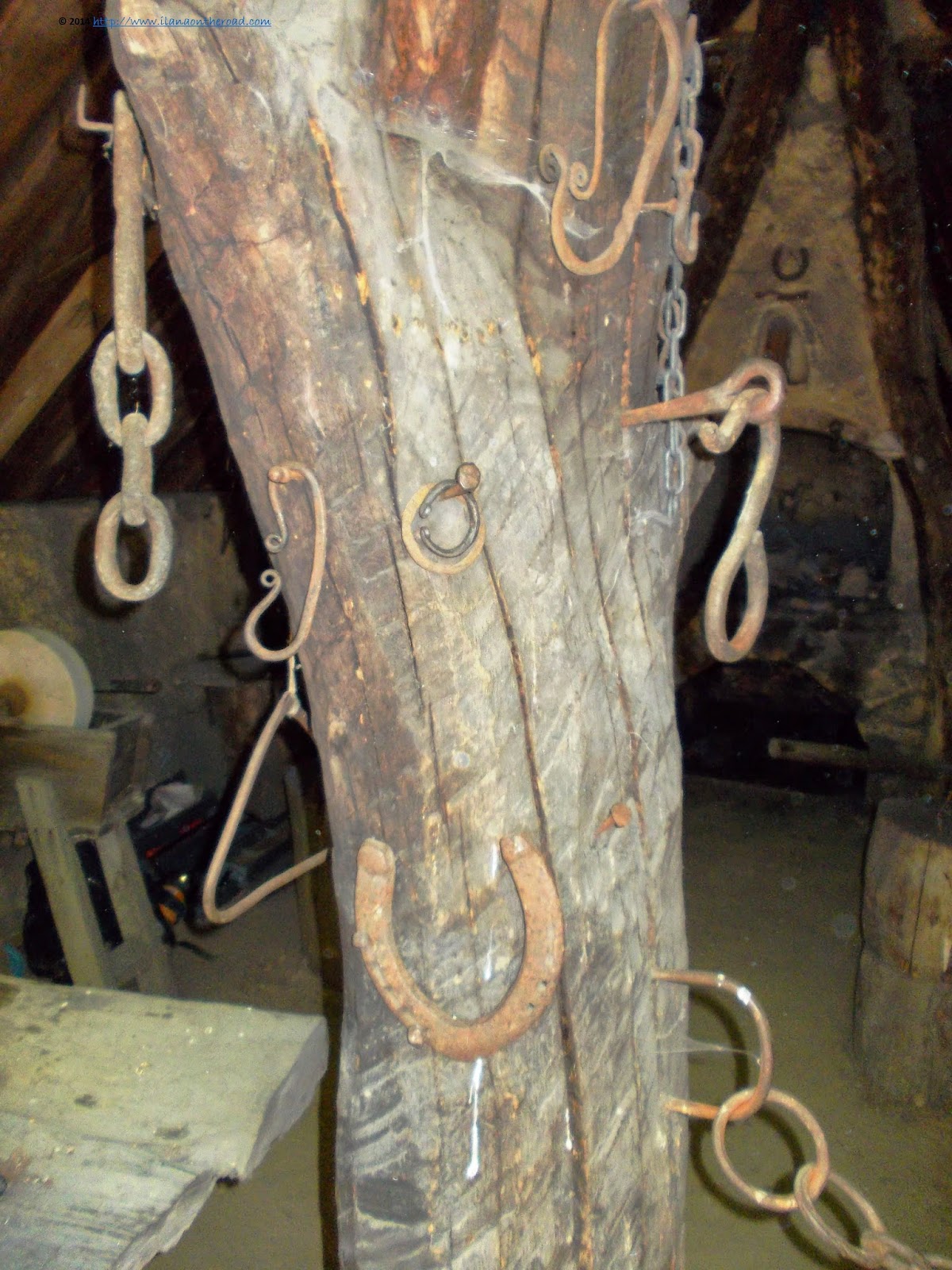
In another corner of the huge park, a live blacksmithing demonstration. The team, among them a woman, were doing their work slowly without being bothered by the curious eyes some of them probably ready to do their own experiment. For someone with two clumsy hands, it looked a bit dangerous so tried to stay away.
More than the live experiments and the food, I loved the idea of reconstructing old habitation spaces. My expectations were a big high initially, considering similar village museum I visited in Europe, but here there is no geographical representation of various German areas, the architectural research being focused on reconstructing the village as it used to be in this specific part of Berlin.
Once you enter the little house, one might be bothered by the lack of light and the cramped space. Sometimes, we forget about how much did it take to acquire the comfort of electric illumination and of high-ceiling condos.
If you ever had the chance to learn weaving, here is the place to try to remember your lessons.
Otherwise, riding a little wooden horse is an experience you will never forget or need to learn for too long.
Thankful for the sun, I took as much time as possible to explore the neighbourhood house by house, not too creative in trying to imagine how the daily life used to be those times. This is how I ended up studying contemporary history, probably.
The merit of this little village is the punctilious concern to recreate a comprehensive landscape of the old village. The work started in the 1970s and lasted a couple of good decades till the final inauguration. For the construction, ancient techniques were used.
The huge open air spaces are offering enough vantage points to relax, with or without a book, and get immersed into the ambiance.
Such a generous space is perfect for children that can jump freely around, playing with various old games. As for me, I tried more than once to walk on stilts without any chance of success.
The beginning of early autumn is the best time to be around, at least for the colours of the fruits - that the visitors are not allowed to pick up. Due to its historical features, the children under 14 are not allowed to visit unattended and climbing the old buildings, as tempting as it sounds, is strictly forbidden.
Under the guidance of their teachers and parents, the children have a lot to learn about the old - not necessarily good - times. A visit to a museum or a live presentation, or even the experience of a pottery workshop can be more valuable than long boring hours in the classroom.
This goes for the old art of cooking too, as old cooking books from the 14th century are available on sale for those interested for a historical menu.
Even though a bit too late, I am happy I finally made it to this medieval village. Till October, I still have time for a new visit, maybe to watch life some chivalry confrontations.