Posts mit dem Label Berlin museums werden angezeigt. Alle Posts anzeigen

Freitag, 1. Januar 2016

A visitor at the Spy Museum

It is not every day that I am very excited about a PR and marketing campaign in Germany. The one for thel launch of the Spy Museum is one of them, and from the middle of the summer the city was invaded by attention grabbing billboards announcing the event. Although I wanted to be among the first to check the fantastic spy adventures announced, I had to wait till the beginning of November until the visit was possible.  
The building in Potsdamer Platz is offering two full floors of historical installations, presenting more or less recent historical spy stories. The lengthy presentations are available in video and written format, in English and German.The visit starts with an introduction in the history of intelligence, from the old Egypt to Rome and Joshua.
Most part of the exhibition is dedicated though to the Cold War times, that made Berlin one of the European capitals of spies. Touch screens are providing interviews about the various genesis of intelligence services in the East and in the West of Germany.
Old stories are presented into a creative interior design ambiance with special effects of lights and shadows.
When the historical introductions are too long - although very interesting, especially with former Stasi operatives, the famous East German secret police - there are some practical example set toexplain to yo how the operative work can be practised. Special secret messages can be hidden in nuts. 
Or in shoes.Or in cigarettes, or in various parts of the car. Practically everywhere. If you are not too strong at heart, you may risk to become very paranoid, even the Cold War is over.
After you see the section dedicated to different gifts that can instantly kill everyone only by smelling, you may need a rehab. The famous umbrella that killed the Bulgarian dissident Georgi Markov in Central London in 1978 is there, still waiting for a full reconstruction of facts, many years after the crime was commited with a simple touch.
True is that at the end of the long visit I really felt overwhelmed about too much information, like I was at the end of a long class in the history of intelligence. Some colourful covers of James Bond movies brought everything back to the entertainment work.
I had a different impression about what a spy museum should be, expecting more action and intelligence challenges, also for the visitor. But I am sure also that the usual glamour we associate with this kind of work is rather the result of wishful thinking. The Spy Museum in Berlin provides lessons of history and for now, it might be enough.

Sonntag, 17. Mai 2015

A visit at the Bauhaus Archiv-Museum

I am a very big admirer of the Bauhaus movement, both as a cultural and an artistic/architectural standard and since I move to Germany I rarely miss the opportunity to document their traces, including by an early visit to Dessau. However, the Bauhaus Archives were somehow missed, probably because I was - wrongly - thinking that there must be only about documents and nothing new can be brought to me already extensive knowledge about the movement. However, one Monday of the last week, I decided that I have to change this, and took the bus till the Museum. First, I had a short meditation on the Herkules bridge, taking the full advantage of the sunny morning. The chaise-longues near the river were inviting to stay more, but decided to keep with the schedule this time.
At the entrance, the project re-use in process to be finished, is aimed to show the different layers of the movement and also to offer a new temporary exhibition place.
The irregular and outsanding building of the museum is one of a kind in Berlin. Initially set for Darmstadt but moved to Berlin in the 1970s, it was planned by the founder of Bauhaus, Martin Gropius, who did not live to see it finalized. The local authorities were not that keen to accept it, and was finished thanks to private contributions. It was the first such archive of the Bauhaus and it used most of the archives donated by Gropius himself as well as by other members of the movement. 
In the middle of the green area, with trees and a small park, the building is a patch of concrete white. The entrance is done through a serpent-like platform, called 'Eternity', in the middle of two independent agglomeration of blocks, parallel and equal to each other, united by a middle section. 
From the top of the platform, I was able to see the simple geometry of the two-story structure hosting the 800 square meters of exhibitional space. 
According to the special wishes of Gropius, this unique post-war modernist building should be renovated and changed only by respecting particular technical and artistic directions.
Inside the museum, a new exhibition introduced over 100 new objects added to the Museum collection. Among them, many black and white photography by Nathan Lerner, Josef Hartwig sculptures, collections of wooden toys and studies about colours, sketches by Ludwig Mies van der Rohe, or the beautiful paper umbrella by Ferdinand Kramer. 
What I admire about this movement is its extensive interest for almost any topic related to arts, from the fine investigation and reevaluation of the properties of metals - an example being Takehiko Mizutani Study in the property of metals, made of sheets of brass superposed - till the focus on how to better teach arts. The archives are carefully tracing the different stages of the movement of the trajectory of some important representatives, such as Kandinsky, Lyonel Feininger, Oskar Schlemmer or Paul Klee. Not to miss also the Marcel Breuer chairs or the spectacular light installation by Laszlo Moholy-Nagy or the project of Germany's Pavillion at the World Expo 1929. The full archives can be also consulted at the library, upon request.
Interior design and architecture are one of the most famous changes brought by Bauhaus and that changed the faces of many cities from around the world (the White City of Tel Aviv not mentioned in the exhibition is the most famous example). According to Gropius, building means designing life processes and an art of living. He was pledging for 'organic designing of objects in keeping with their own present-day laws, without any romantic goss or fanciful frills', 'limitation to typical primary forms', use of 'colours that anyone can understand', 'simplicity and multiplicity', 'economical utilization of space, material, time and money'.
We can hardly understand the contemporary architecture today without Bauhaus and the Archives are a good inspiration for anyone trying to learn more about, either as a curious tourist or as an artist/architect-in-the making.

Mittwoch, 12. März 2014

From Museum of Medical History to Surrealist Objects, Berlin has it all

Spring was early in Berlin this year, and the winter almost non-existent! Overwhelmed by so many sunny days, I spent a lot of Sundays outdoors, discovering old corners and revisiting old ones. Not necessarily on purpose, one of those days, I decided to discover by foot the area around Invalidenstrasse. I left the bus around Reichstag/Bundestag that I visited at least twice since moving here. Right now, the visitors should register online a couple of days in advance. There are long lines of visitors always, but as far as I remember, it goes relatively easy and within 30 minutes you can start the tour. 
After the visit, one can admire the new diplomatic and governmental architecture, a topic that I promise to come back in detail soon. As it was Sunday, there was no one to be seen around the otherwise busy offices.
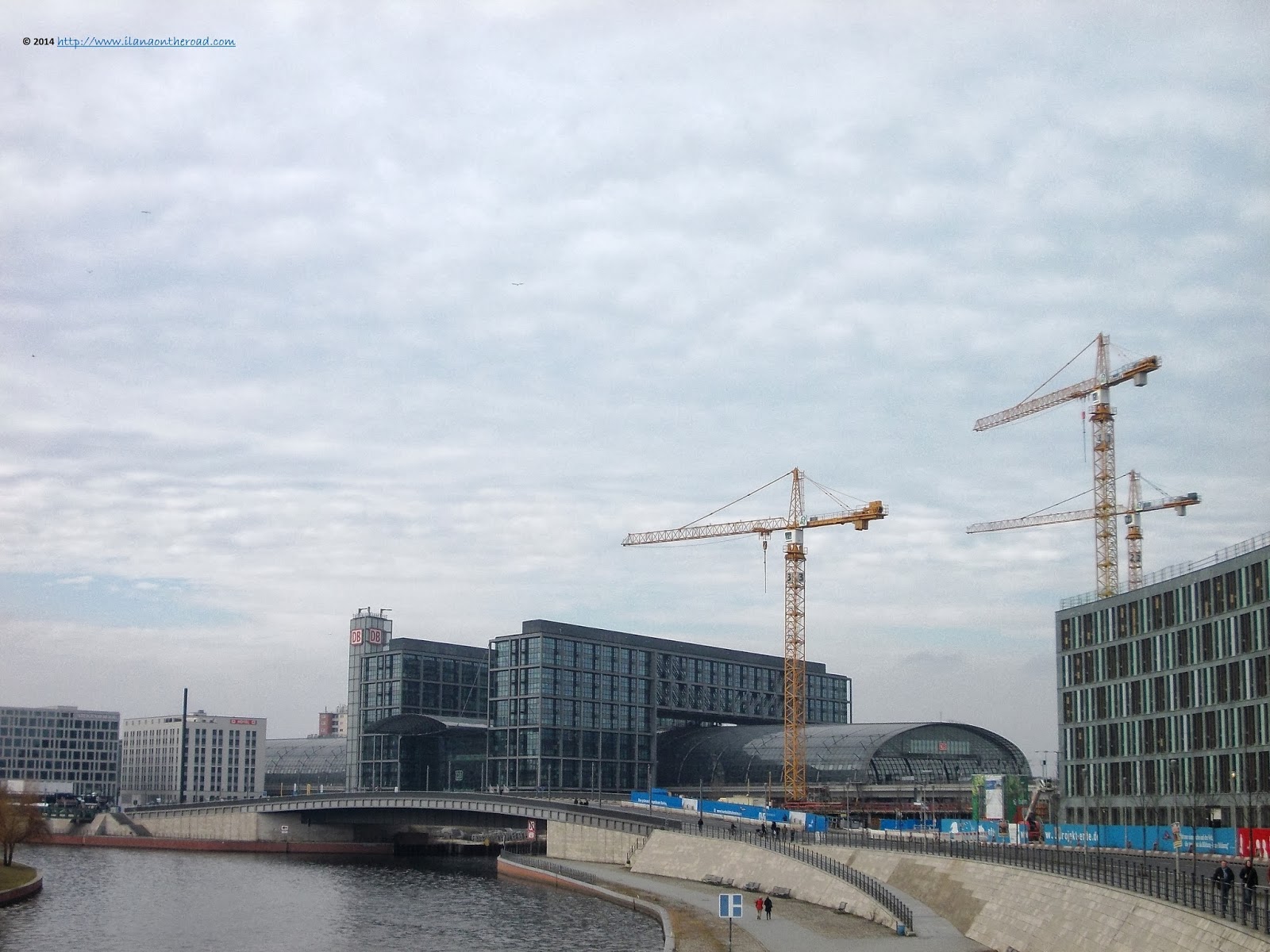
The Central Station/Hauptbahnhof remains a benchmark of my first ever visit to Berlin and Germany. Since then, almost 10 years later, there is still a lot of work around as the constructions seem to be a permanent work in process not only in this area, but in the city in general. 25 years after the fall of the Wall, the city is still looking for its architectural identity. 
But there are also things that don't change too much, some of them for many centuries. The Museum of Natural Science is a destination in the area for over 200 years. I visited it a couple of weeks before and was surprised to see how many people of all ages are curious about science. At the first floor, there is a collection of minerals from all over the world. After the separation of the city, the museum was part of the GDR and many scientific travels took place in former communist countries, such as the Soviet Union, Cuba or Mongolia. 
There is a lot of work going on around Invalidenstrasse right now, for the reconstruction of the tram line. The area promise to be one of the new centers of attraction in West Berlin. There are many bars and hotels around, many newly open, such as the welcoming Hotel i31, that I visited a couple of months ago. 
Close to the Central Station, if you walk for around 10 minutes, you will discover the medical compound of Charité hospital, the oldest and most famous medical institution of the city, and the largest university hospital in Europe. Statues of famous characters of the German medical history are everywhere. One of them is Albrecht von Graefe, labelled the 'father' of German ophthalmology, whose son bearing the same name chose to follow a sinister far-right career.   
Many of the buildings were originally erected at the beginning of the 20th century. Kaiserin Friedrich Haus, is nowadays part of the scientific network of the hospital, but during the GDR it hosted the Academy of Arts. 
We enter inside the Charité compound, walking silently the labyrinth of sober red bricked houses. The hospital was initially established at the beginning of the 18th century, in the aim to counter the effects of bubonic plague. It was used for a long time as a charity (hence the name, in French, sign of the constant influence of the French culture in the Brandenburg area) hospital for the poor. Nowadays, is treating high-end personalities and any kind of maladies. One of the recent hosts is the Ukrainian politician Yulia Tymoshenko. 
The Museum of Medical History was on my priority list for a very long time. Now, I was finally able to have a visit that included an exhibition about the evolution of the relationship between doctors and patients. A whole level is dedicated to various physical deformities and the evolution of investigation practices. If you visit the museum if children you should sign a declaration that you agree that they are exposed to such scientific realities.
The museum also preserved the anatomical theatre, once used for dissections. There are also a section covering the use of medicine for political means during WWII, relatively in a discrete corner.
A trip to this museum is very intense, but otherwise, on the opposite part of the road, there is the more brain friendly Museum of contemporary arts, in the former Hamburger station.
But we did not want any museum for the moment, until walking Torstrasse we found a very special one: The Surrealist Museum of Industrial Objects. The name reminds me of my long 'dadaist' period and is hilariously sympathetic. 
From there, we walked a little bit more till Oranienburgerstrasse, a colourful oasis full of locals and visitors enjoying the first sights of the spring. Hungry, decided that it is about time for a stop and the Kebab Baba, a Turkish place I didn't notice before - maybe because is near the very popular Dada Falafel, where I used to go quite often some time ago - was inviting enough. But despite the traditional interior, I preferred to eat outside, enjoying both the food and the show of the street.
With my 'veggie dish', I tried to catch up with the lost energy after hours of wandering the streets and museums. The combination was great: salad, a borek, falafel, potatoes, eggplants and couscous. Authentic, rich and healthy enough. A good treat at the end of the day.
After a couple of months when I avoided to walk for too long in the city, the spring reminds me that Berlin can be not only beautiful, but interesting enough to keep me outside for more than 8 hours. It can be the beginning of a new old routine.

Sonntag, 24. November 2013

Afternoon at the Ceramic Museum

Almost three years ago, it was a beautiful spring day and I left home having in mind to visit the Ceramic Museum. But I don't remember what happened and my plans were switched for some outdoor activities probably. This time, with the snow being around the corner, it was cold enough to be very strict about my schedule. The small museum is situated in Charlottenburg, a couple of minutes away from Richard-Wagner Platz U-Bahn station. 

The visitors are invited to see three different exhibitions: one permanent collection of German porcelain from the 19th century, and two other temporary exhibitions changed almost every 6 months. The main collection includes beautiful samples of local art, with or without flower and natural prints in general, produced by German manufacture. Many of them were and still are popular items in the living rooms of the middle class local society.

The exhibition halls are distributed through the building. The museum is hosted in the oldest construction in Charlottenburg, originally built in the 18th century. What is nowadays the main garden with stylish arcades used to be a huge dancing hall that was destroyed over night by the 1980s owners. A very bad and unauthorized decision, as the building was and still is part of the local heritage. After this experience, it was transferred under the authority of the townhall who subsidize it.

One of the main temporary exhibitions features the coffee and dining culture from 'Urbino' to 'Stambul'. It presents various items produced by the KPM Porcelain Manufactur in the 1930s and later on, one generation later. It features various works by Marguerite Friedlaender and Gerhard Marcks, brand names of the local design scene for years. It is not easy to find the charm of the strict monotone geometry and the strict lack of colour diversity, but there is some mystery of the geometry that cannot be neglected. The exhibition hall has also a small corner where the coffee drinkers can rest and sip their take away coffees in an inspiring ambiance.

The last exhibition is dedicated to the German artist Walter Rhaue, that brings back the colours into my day. Besides the religious subjects, he also decorated plates and small statues in lively nuances and in a humorous way. 

I wished my visit in this warm space with so many colours and shapes lasts longer. Before leaving, I had a look at the selection of books from the local library - good looking hard covered books with many useful information about the German porcelain traditions - and was introduced a bit more into the history of the building by the director of the museum. This may be the advantage of visiting a small homely place: you will always find nice people ready to tell you local stories. 

Montag, 12. August 2013

A Foreigner at Berlinische Galerie

I still have a lot of things to learn both about Berlin and the history of visual arts in Germany so when I find an occasion to cover two topics at once, I can't say 'no'. I wanted for a long time to visit Berlinische Galerie but somehow for years I only went in the neighbourhood once or twice without being tempted to enter. Last week, I took one day off from my home office for discovering a couple of museums and galleries that were on my priority list but without a specific reason slipped on second or thirds places. Thus, watch this blog for more museum wanderings and wondering to come in the next days.

The entrance to the gallery is fully in accordance with the spontaneity of modern arts: a 'carpet of words' that introduces the visitor to the temporary and permanent exhibitions of art. The temporary exhibitions are situated on the ground floor. This time, the space was shared between: the winner of Vattenfall Contemporary prize Katja Strunz exploring the monumental architecture; the photographer Tobias Zielony introducing the Trona community from the Californian desert - described in a couple of words by a youngster living there as follows: 'When you have absolutely nothing to do you do bad things' - and a moving visual investigation into the world of sex slaves. A more optimistic and creative mood is brought by the collages of the German artist Henning Bohl. Another interesting exhibition is dedicated to the recent history of the new governmental district in Berlin, especially after the unification. As in the case of many other areas of the city, it is still work in process.
The architecture of the gallery in itself is very creative and set to offer a lot of space for exhibition while leaving enough privacy to the visitor to grasp alone the symbols of the visual challenges. The first floor is dedicated to the history of contemporary arts in Germany, with a specific focus on the work of those having Berlin as their creative headquarters. The space is getting smaller but big enough to offer a panorama of the state of the arts from the end of the 19th century till the post-war period.
Dadaist constructions
The history of German arts cannot easily be separated from the history of the country in itself. It sounds very natural for me, but I am sure many supporters of the pure arts-for-arts perspective will not agree with me. The historical illustration is mostly covered by the collection of photography exhibited, such as Erich Solomon's, Lotte Jacobi (author of one of famous Einstein's photos) and Rudolf Schlichter's presented various stages from the history of Berlin. Among the other works presented are those signed by George Grosz, Felix Nussbaum, Naum Gabo, El Lissitzky or Arthur Segal. So many things to see and understand that I would love to be back soon, eventually with someone able to tell me more art stories.