Donnerstag, 23. April 2015

Small tips for a big city: Kurze Strecke Taxi ride

Every day, Berlin seems to surprise me with new tips and ideas that I hardly knew about it. As usual when you travel, either long or short term, it is important to count on the opinion of the locals or people with extensive experience in knowing the city. A couple of days ago, I was busy to be in time to a conference with a friend of mine, a dedicated Berliner for more than 20 years. Although not born in this city and not even in Germany, through the everyday interaction with the people she is a living testimony of all the changes this city went through in the last decades.
This time, she offered me another lesson about the city, to me, the one that I dare to consider myself a kind of expert in all things Berlin. As we were a bit late and too tired to run very fast till our destination, she told me with a very quiet smile: We will take the cab! I am usually a big fan of taxi rides, even in the very expensive London, but when in Berlin, I never felt the need to do it, except maybe 2-3 times when I really did not have any other choice. But this time did not feel that this is exactly the case. My friend, noticing my untold opposition, added: We will take Kurze Strecke, of course? This time, I dared to reply, as did know that this Kurze Strecke is available only for 4-station ride with bus, train or metro: What does it mean? Of, you don't know...told you that you should learn a lot about this city...she said. This is when you go with the cab only for 2 km. and for a fixed price: 4 Euro! The idea to stay in a comfy Mercedes taxi for a couple of minutes and only for 4 Euro sounded too good to be refused. The condition is to take the cab from the street. 
We took the cab mentioning the destination and the label of our trip: the already famous Kurze Strecke. No comments from the driver and in just a short while we were at the conference, taking the last free seats.
Warning: this awesome offer is available only within the Berlin Republic!
Enjoy your short taxi ride!

Sonntag, 19. April 2015

Tel Aviv visits Berlin at Martin Gropius Bau


Since the end of March till the 21th of June, Martin Gropius Bau is hosting a very interesting exhibition of over 70 masterpieces of art from the Tel Aviv Museum of Art. Organised on the occasion of the events held for celebrating the 50th anniversary of the establishment of diplomatic relations between Israel and Germany, it aims to bring to Europe not only special works of art diplayed for the first time on the continent, but also samples of contemporary Israeli art. 


Tel Aviv Museum of Art was established for the first time in the house of the then mayor Meir Dizengoff, the new headquarters of the 5-story Amir building labelled as a sample of 'Israeli brutalism' being inaugurated in 2011. A short ironic graphic montage tells the story of the first museum, with added photographic details of the current compound. The exhibition is organized according to different thematic sections, featuring nature, women, the old world etc. It features 20th century artists, many of them with a certain connection with Berlin and Germany such as Kandinsky, Lesser Ury, Max Beckmann, Felix Nussbaum. Most of the works belong to Jewish artists, featuring abstract art, such as the beautiful Bewildered World by Max Ernst, Marc Chagall's Solitude, the very rare Had Gadya illustrations by El Lissitzky, Jackson Pollock outburst of colourful emotions, Chaim Soutine or the special Blue Leaves by Arie Aroch. Personally I was happy to admire the rain of light colours from Paul Ensor or Paul Signac landscapes, Mark Rothko's No. 24 - which is opening the exhibition, the Zurich Ball of Marcel Janco, the Venetian woman by Giacometti or the Old Synagogue by Issacher Ryback, Danseuses by Degas, Egon Schiele and the work of the interesting Arshile Gorky. Interesting works presented are also Lady Lilith by Dante Gabriel Rosetti, Alexander Archipenko, Edvard Munch and Pablo Picasso.

Although I find the selection of contemporary Israeli art - mostly art installations - at centuries distance compared to the 'classical' works, I found the installation by Michal Helfman at the end of the exhibition, an interesting idea. Accompanied by music at certain moments of the day, it develops the theme: 'While dictators rage'. The kites projected on a murky sky are creating the stage for a violing and clarinet concert interpreting a musical piece featured in the 'Triumph of Death' by Felix Nussbaum. 
Out of darkness and persecutions, the spirit triumphs against death and rage of idols. The diversity of the works and styles features at this important exhibition is not only a sample of creativity but also of human perspectives and European history. 

Montag, 13. April 2015

Discovering Schmagendorf

With almost seven years of constant experience of discovering more new and new corners of Berlin, I am almost sure that there are few things left to really impress me. However, one day at the end of the winter, while walking for a couple of hours around Hohenzollerndamm, I discovered a little unexpected island: Schmagendorf. As I felt attracted by the mixture of old Berlin style, new and old architecture and a lot of new modern restaurants, I decided to come back later a couple of weeks later, in one sunny day to carefully document this neighbourhood. 
I started my walk at the historical Hohenzollerndamm historical train station, walking slowly the long avenue with the same name, for almost 30 minutes. There are not too many shops around, and only few scattered restaurants, many medical cabinets and pharmacies, with the only main attraction being the Ice stadion whose season just ended. The only bus connecting with the rest of the city is no. 115, but this time I was rather interested to walk discovering ineresting architecture styles, houses and eventually the people living here.
From Elsterplatz, I followed the touristic arrows indicating the direction of Townhall Schmagendorf, via Berkaerstrasse. Dominated by the castle-look of the town hall, the street also has modernist samples of architecture, and a relatively fancy Italian restaurant, Lucullus. The sound of the music lessons held in the old townhall rooms, resounding from the early spring open windows, gave to the entire area a certain irreal flavour. The area at the intersection between Berkaer and Breitestrasse keeps an ambiance of the 1950s. At the no. 31-35 on Berkaerstr. it used to be the Jewish old people's home built by Alex. Beer. At Hundekehlstr. 11, Rainer Maria Rilke wrote in 1899 the Cornet poem. 
The first time when I arrived in the area, my imagination was challenged about the brick-Gothic style of the townhall and wanted not only to find out more historical facts about it, but also to go inside, searching for more secrets. Outside, the architectural style was influenced by the trends used for public institutions in Brandenburg area at the beginning of the 20th century. The round over tower is crowded with battlements and cone-shaped cap towers above the steep gable building., made of several parts. Inaugurated in 1902 as a townhall, in 1920 was downgraded only as a town registry, following the incorporation of Schmagendorf into the Wilmersdorf district. Here married Romy Schneider as well as other German personalities.  
But the discoveries inside the building are even more interesting. The serious arches made of the red brick stones are watered by the reflection of light filtered through the stained glasss mosaique. A discrete notice on the corner of one of the works mentions that the work was created by Helena Starck Buchholz and set up by August Wagner. For now, the building hosts a children library and a music school. The voices of the children running fast to start their music lessons or to take a new book from the library add even more life to the sober interior. 
On the streets around, the spring invited everyone to go out of their houses, so I can see the many generations of people living here. As in many other small neighbourhoods of Berlin, you can have here almost everything to make your life comfortable without going too far away of your comfort zone: a flower shop, a computer shop, a couple of local bookstores. Another Italian restaurant, Nuovo Mario, am Koeberger Square is half-full at this mid-day time. Every Saturday, on Reichenhalterstr. there is a flea market, with cheap food or home products offered to the locals. 
As in any respectable Berlin Kiez, it has its own bio store: Hofladen im Kiez, with fresh pastry and various ecological products, including a colourful healthy selection of fruits and vegetables. 
And I keep exploring, from the big avenues dominated by classical West Berlin buildings, to the local small veggie store on Friedrichshaller, My & Minh Sushi Viet bar, or the Casa Delizia Italian restaurant that already serves the menu outside. 
Once arrived on Breitestr., the life is getting very busy. At the old style Jebens Konditorei, classical German sweets are served and you can hardly find a free table right now. At no. 20, a mysterious yard is hosting various Artists' workshops, with special discounts for various classes. A bit far away, there is Dschunke, introduced as one of the oldest Chinese restaurant in West Berlin, as well as a small welcoming bookstore. 
But, what is happening here? After a relatively friendly winter, people, especially the smallest among us, are waiting impatiently to have their small portion of delicious Italian icecream. It was about time!
Back on Barkaerstreet, I feel that at least for now, my short journey to Schmagendorf is about to end. After a last look, and a couple of more pictures of the townhall, I am back on Hohenzollerndamm. The announcement board near the Carl Orff school anounces the schedule of the next meetings in the neighbourhood, varying from cooking classes to different lectures. What else can you want more! Life in Berlin seems to be interesting, whatever where do you live! With the spring already in town, it seems that there will be a lot of new things to do and to discover around!

Dienstag, 7. April 2015

Israeli lunch and unforgettable Pavlova at NENI

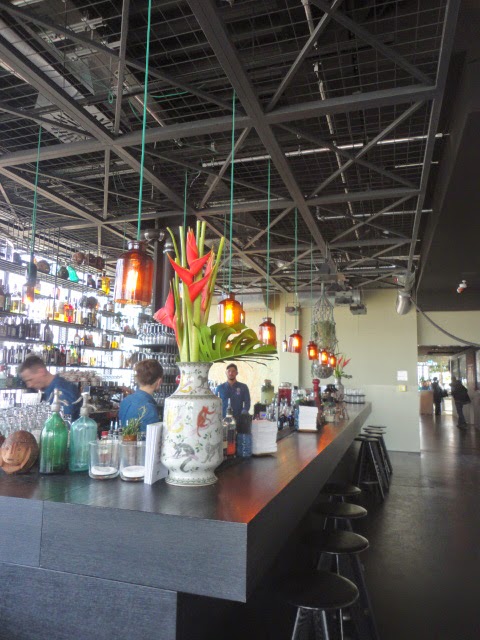
The 25 hours hotel bikini Berlin opened more than one year ago, and pleasant gossips about good food and interesting interior design reached my foodie ears, but although I am visiting the vicinity at least once the week, I did not dare to go further on from the hipsterish entrance. Till one day, when too tired after an early spring trip through Tierpark I went straight away, passed the Trabant in the lobby and went up to the 10th floor to NENI restaurant and its Monkey Bar. As usual, my spontaneous plans bring always the best results.
The elevator stopped directly to the 10th floor and for the beginning, made a tour of the Monkey Bar, with comfy sofas covered by colourful pillows outlined by mysterious lights in the corners. It is mid-day and the ambiance in the lounge is chilling, with some people eating from the plates resting on their knees, everything under the playful eyes of the monkeys on the metal plattered walls that reminds some old temples in Thailand.
Similarly with the design of the neighbouring Bikini concept stores, the ceiling is an intricated plumbing labyrinth, but the flower decorations, and the bric-a-brac of vintage objects exposed on the massive counter brings a note of irony and home feeling to the huge space. 
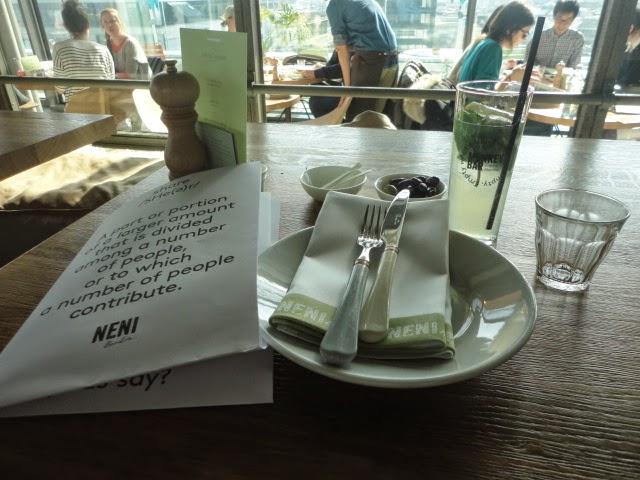
Colours and the natural light are dotting the massive wooden blocks. Cocktails parties are often held here, under the motto of Balagan, the Yiddish word for overwhelming chaos - a leaflet at the bar describes it as a 'sympathetic chaos'. As the hunger won over my interest for design and etymology, I promise to think more about it when I will for some cocktails. 
It is one sunny day, so I stay a couple of more minutes on the terrace, admiring the view over Ku'damm and the KaDeWe. As everywhere around, there is a lot of green which makes the stay even more enjoyable. In a way, it reminds me of the nice green rooftops of Tel Aviv, always ready to welcome unknown guests for the long summer parties. 
But it is time for real food now, otherwise the brain cannot think. Not as fast as I wish, because there is a long cue and I have to wait in line to be seated. As usual, since living in Europe I forgot how important a reservation can be for a successful lunch, but luckily, there are some places left for the spontaneous type of humans. 
After being seated, my order is taken even faster, by one of the many people running around as organized bees. Despite the full tables and the Babel of languages, everything goes rapidly and you feel like home. You can even have a look at the kitchen, where home-made recipes are prepared. It seems that the idea of the founder of NENI, the successful Haya Molcho that moved from Vienna to Berlin, to make the restaurant more than an eating place, but a place you feel like home, was successful. NENI stands as the acronyme of the names of her four sons: Nuriel, Elior, Nadiv and Ilan. 
The menu is not that long, but has so many dear recipe names to me that I don't hesitate a second before ordering: a lemonade, prepared according to the highest standards of the Tel Aviv restaurants (the kind that I am longing for for centuries in this city), cold, with mint leaves and balanced portions of sugar and lemon; sabich; and...some special sweet non-existent in Berlin till now whose name I will disclose later on. While waiting, some fresh olives covered in spices and olive oil make me dream about sea and the summer.
The place looks like a huge eatery, with a podium in the middle with more tables, under a coverage of green plants hanging from the ceiling. Tables are also set outside, where one can admire some fancy parts of West Berlin while eating. 
The pita is so fresh and moderately warm that I can spend hours eating only it. The sabich is prepared according to secret directions known only to those who are familiar with the Frishman beach restaurant. It combines a finely fried eggplant, roasted carefully in order to let the flesh fresh, plus some special hummus, spiced, and slow poached egg. Using the traditional recipe, it brings a new fresh taste, brought by the art of combining skillfully the spices. The local cuisine of NENI combines the family knowledge that has Israeli, Romanian and Spanish influences. Temping meals as chraime - a special recipe of Moroccan fish - babaganoush, 3-colour hummus (curry and red beet, besides the classical one) or the well-known shakshuka are encouraging me to make my foodie wish list for my next visits. There are also meat-based dishes and a variant of the popular Ruben sandwich.
The queen of my menu is called Pavlova. This is a fantastic sweet, whose memories are hunting me for years. In Berlin, every time I asked, I was received with suspicion, silence or surprise. Here, it is part of the menu and no one looked at me with big eyes when I ordered it. Wish I was able to have more and more portions. Made following a recipe of Haya Molcho, it combines the softness, sweetness, and freshness of the meringue with whipped cream but also some sour taste brought by the red sauce, and a very special note brough by the mint. Perfection for me!
Happy with my choices, I decided to leave in time, generous enough for letting other people too the chance to taste so many delicious foods. The prices are moderate to high, but in the case of my orders, it deserved every single Euro. 
With so many Israeli visiting and even moving to Berlin, it is about time to bring some changes to the local cuisine. NENI is a very good example that will feed my foodie dreams for a long time now.

Freitag, 20. März 2015

Art at the City Hall: Wilmersdorf Kommunale Gallerie

Compared to many big European cities, including Paris, Berlin is attracting more and more artists from all over the world. Besides the affordable cost of living, there is also something else that brings them here: the many chances offred to creative people to work, including by offering them cheap or even free workshop places and the many opportunities to sell and exhibit their work. An example of institutional interest for the arts is the fact that many borrough city halls do have interesting exhibition spaces presenting regular exhibitions and used as meeting points of the artists. This week, I visited the Kommunale Gallerie of Wilmersdorfer City Hall, close to Fehrbelliner Platz U-Bahn station. The entrance is free and there is a huge 1-storey exhibition place, hosting right now two exhibitions, workshops and a big room with various work of artists on sale or that can be loaned for a couple of days.
The exhibitions that I've seen here before feature usually Berlin artists, some of them living in the area, focused on contemporary arts and photography. Group exhibitions are also common, some of the artists being locally supported. 
The hall was quiet, with the three people employed by the gallery moving slowly near the reception desk, ready to welcome the visitors or to give explanations, if needed. Also at the entrance, there are plenty of leaflets introducing various local cultural events as well as other exhibitions at the other city hall galleries.  
The enormous space of the first floor is dedicated to feature the post-war Berlin artists and the recreation of the new art institutions. The exhibition, open till 24 of May, has interesting artistic insights, but also information about the artists and their personal histories and efforts to reconsider the artistic life. 
The visit at the Wilmersdorf Kommunale Gallerie was intense and taught me a lot about Berlin and its artists. it also made me curious to explore the other galleries hosted by the other city halls. As the spring seems to finally settle down in the city for a while, I can't wait to see more samples of cultural life in one of the hottest cultural cities of Europe right now. 

Montag, 16. März 2015

Rolls Royce on Ku'damm

For a couple of good years already, I am living in the country of the most envied cars in Europe and in the world, and despite my very limited technical knowledge I am doing my best to understand the high precision of the German cars. However, my secret passion are the big adventurous English and American cars. A matter of taste, I know...At the spectacular BMW Building on Ku'damm nr. 31, it was opened a couple of weeks ago an exhibition dedicated to Rolls Royce (opened from Monday to Saturday between 10am-8pm, Sunday between 11am-6pm) that I could not miss to see. 
Do not expect too many cars (this was my big disappointment) and the big cars are silenty watched, and from time to time also cleaned from dust, by local employees. Mr. Rolls and Mr.Royce plotted the creation of Rolls Royce at Midland Hotel in Manchester in 1904. Rolls was the first undergraduate to own a car, and Royce, sold newspapers in 1893, and in 1887 registered his first patent, the bayonet clamp socket. The motto of the company, still proudly followed nowadays is as simple as that: "Strive for perfection in every thing you do. Take the best that exists and make it better. When it does not exist, design it".
The models displayed represent different technological stages and historical style. My favourite by far is this beautiful 1926 Phantom 10 Ex Open Tourer. "Ex" stands from Experimental, but looking at it, it seems that it was a very successful experiment. 
 On the other end of the room, an impressive 1964 Rolls Royce Silver Cloud III H.J. Mulliner Flying Spur.
The exhibition is elegantly set up, besides the cars, being displayed various designs of engines, technical features of the cars - in English and German - as well as a short history of the company, plus a collection of personalized branded gadgets on sale on the spot. 
The Phantom Drophead Coupe may look a little threatening, but besides the armoured presence there is a lot of elegance and precision used to put together so many small little pieces and details. 
The elegant leather interiors, with comfy chairs and high-end safety standards just reminded me that sometimes, big cars can be beautiful and elegant.

Sonntag, 1. März 2015

Foodie Berlin: Chao Pure Vietnam

After my glorius foodie experience at Good Morning, Vietnam, on the Eastern side of the city, I did not find any similar high-appreciation, although I did my best to find. Things changed completely a couple of days ago, when not too hungry, but exhausted after too much walking around Ku'damm and Savigny Platz hunting for subjects, I stumbled upon the newly rebranded and renovated Chao, situated on the already famous fodie avenue of Charlottenburg, at the no. 33 of Kantstrasse. It was around the lunch time, shortly after the opening, at 12 o'clock, in the middle of the week and for more than one hour I was the only guest. The ambiance was relaxing, with some soothing house music in the background, with fast and friendly service and menus written in both English and German.The toilets are not extremely stylish, but very clean. 
 Besides the service, I really apreciated the interior design, with big beautiful pictures from Vietnam, bushes of natural bamboo and small natural flowers and romantic candles on the table. I repeated 'natural' on purpose, to make the difference  with many Asian restaurants where the dusty and kitchy plastic flowers are the queens of the table. The furniture looks a bit unmatched and not that modern, but the glassware looks authentic, with some beige variations and bamboo chopsticks. The prices are moderated and regularly there are special lunch offers.
I started my lavish lunch with a Mekong Mystery drink - a delicate smooth combination of mango, coconut milk and mint. Naturally sweet, creamy and brought cold, made on the spot. The mint brings some sparkling accents, while the mango fits perfectly with the coconut to whom it brings discrete sweetness.
 My favourite choice were the summer rolls, with tofu, coriander and many vermicelli, accompanied by soy sauce. The tasted are coming along together very well, and the light fried tofu makes a difference among the many fresh vegetables and the neutral vermicelli.
Curious to taste as many meals as possible - although there are at least two more choices, plus some tempting desserts that I would love to try a next time - I continued with dau phu sot lac: a mountain of veggies soaked in peanut sauce accompanied by a pyramid of rice. The rice was very good, but somehow found that some of the veggies were not well cooked - the carrots - or not necessarily at their place there - the tomatoes, for instance. The slices of tofu were welcomed, but did not always complement the abundant cooked and fresh vegetables.
At the end of the meal, the traditional cold Vietnamese coffee. The long spoon is for mixing hard the milk and sugar.
The overall impression was good - except the last minutes spent there when I felt some cigarettes smoke coming from the direction of the kitchen and did not enjoy it - with good prices and enough interesting meals on the menu that may bring me back very soon.