Montag, 10. August 2015

A different Museum of the Allies

I consider myself quite a knowledgeable person when it comes to every hidden museums of Berlin, but it seems that as in the case of many other issues, it is hard to keep up always with the changes. As usual, the more I walk in less known place, the more I learn about the city. No wonder then, almost one month ago, while doing research before the European Maccabi Games, I discovered the West Alliirte in Berlin Museum. It is a free private museum, hosted in a small house with a view over the tennis courts of the Stadium, open only on Wednesdays, Saturdays and Sundays or by request. 
For a rainy Sunday afternoon, the museum was quite full of visitors, from all over the world. Situated in what once used to be the British sector, it offers a variety of objects from the everyday life of the troops and the military stationed in this part of the city. Noteworthy, compared with the similar museum from Clayallee, it focuses more on the British and French sections. 
Do not expect surprising revelations or some information that may change dramatically your perception abou the post WWII times. The visitor will find a lot of basic documents - in the sense of the new history trends - about that times, from uniforms to issues of the French Gazette, warning signs and objects used in the daily life of the military. 
The space is not that big and the materials not necessarily punctilioulsy organised, but someone with already a basic knowledge about those times will have a better picture about the daily life on that part of the Curtain.
By using objects provided by private collections, various camp facilities were rebuilt.
A lot of documents and reconstructions are dedicated to the time of the blockade when, among others, Hershey's chocolates landed in Berlin, throwed up with white napkins as parashutes from the Allies airplanes. 
Walking the museum was an interesting applied lesson of history, always interesting, especially when it comes to facts that are still part of the everyday life. Sometimes, in order to understand complex things, you need to start by basic daily facts and this small museum has the potential to bring something different to its visitors. Cold War histories are still popular in Berlin.

Dienstag, 4. August 2015

Foodie Berlin: Lemon Leaf Indochine cuisine in Friedrichshain

If I want a genuine Indochinese menu, it is very easy to find a good restaurant in France, but till now never was desperate enough to have a look at the German offer. I did not see too many restaurants with such an offer either. When one week ago I finished some meetings in Friedrichshain and was left with a bit more time for myself and seen the Lemon Leef inviting menu, I decided - after another tour of the streets around and some deep thinking about what I really want to eat - to give it a try. 
There are outside tables the type you will find in any beergarden, the best place to observe the coming and going in Friedrichshain, but the indoors is decorated pleasantly, with many colours and colourful umbrellas. Everything looks clean, with the toilets modestely clean. If you are on your own, you can find some newspapers and reviews to fill your time while waiting. As each of the dishes is prepared in the wok, the guests are warned to be ready to wait a bit longer. 
However, take this mention as a sample of good Asian politeness, as I did not feel that I had to wait more than 15 minutes, and the drinks are usually brought within minutes. My drinking choice for a hot day was Mekong River, home made ice tea with fresh limes and brown sugar and as requested, many ice cubes: slightly aromated and refreshing enough to make me forget about my usual choice of Vietnamese coffee with sweetened condensed milk.  
Not a bit soup fan, but this time, really wanted something completely different and ordered Canh Khoai Mon: taro coconut milk with chilli, celery, zucchini, leak, coriander and roasted peanuts. Served and preferably eaten hot, it is unexpectedly sweet, with some spicey balances brought by the chilli and beautified by the coriander smell and aromas. After more spoons, you will discover how spicey it can be. Indochinese cuisine summarizes the Laos and Cambodian food, which usually keeps up with the rich vegetable menu of the Vietnamese, to which many spices are added. 
I got to know the real strength of spices in my next meal: Phad Indochne. A rice noodles dish, with eggs, curry, Cambodian green onions, tofu, chillies, pak choi, soy bean sprouts, paprika, carrots and cashew nuts. It loooks as an innocent combination but it hot, hot hot. That hot that you may really lose any sense of other specific taste. The solution is just give your full attention to the sprouts and eat them in bunches as a balance to the sauce and chilli. 
The meals do have meat as well, but can be prepared with tofu as well. The prices are moderate and the menu rich enough to give a second try.

Sonntag, 2. August 2015

Caran d'Ache has its one and only shop in Berlin

Switzerland is famous for its chocolate, watches and gold, but there are many other products sharing the label of high Swiss quality standards. If you are an artist or knowledgeable in things connected to art, you might have a reaction when you hear about Caran d'Ache, the famous brand from Geneve specialized in painting and writing products that celebrates this year 100 of existence. As it just opened its one and only store in Berlin just a couple of weeks back, I hurried up on Uhlandstrasse 19 to visit it. Till now, its products can be purchased from different locations in the city, including from the KaDeWe.
The self-labelled boutique is not only elegant and designed with good taste, but deserves an additional star for the friendly customer service (which given my generally bad experience in this respect in Germany is a great asset). It displays the usual products offered by the company, including the high-end pens that can be engraved and personalized by demand.
All the products are brought from Switzerland, where they have their own manufactury. The prices are a bit more than the average, but if you are really into arts, you may know how important is to sacrifice some daily luxury for quality.
As for me, not necessarily an artist and bit the extra-budget mostly dedicated to my trips and foodie experiences, I feel like a kid in the toystore. If needed, which products will tempt me more: those colourful pencils?
Or rather these metallic shades that after testing on the spot I decided that are one of the best for my secret artistic plans?
 The products are subject to the strictest quality control, both when it comes to the materials and to their source. The colour pencils and inks are systematically tested for their lightfastness. The fountain pens and ballpoints are also verified for their priming quality and routing flow.
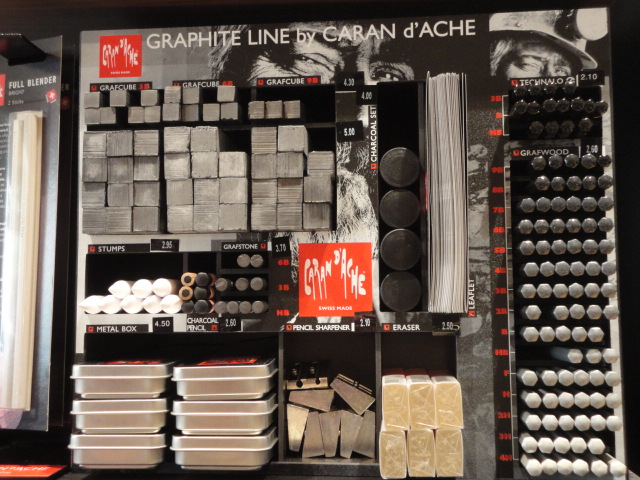
Such products can be matched only with perfect accessories, such this big sharpener suited for the high demands of the Caran d'Ache wood. 
The opening of Berlin shop is outlined by a special collection of very colourful pens, featuring the famous symbol of the city. They look light, practical and with an elegant touch. 
The name of the company, Caran d'Ache is the pen name of the Russian-born illustrator Emanuel Poire. It comes from the Russian word of Turkish origin, karandash (kara means black in Turkish) and has to do with the material the graphite is made of. The graphite displayed in the shop is made of a natural material found in the mountains of Switzerland which served as the inspiration for the firt pencil factory in Switzerland, opened in 1915. 
Their products were close to the heart of many artists, among which Picasso too, to whom is dedicated a full special collection of pencils. 
As I was still wandering around the shop, thinking what exactly would love to bring home, I discovered this huge box, with all the drawing materials needed. As it costs around 5,000 Euro, it seems that I would need a lot of extra jobs to save money in the next years.

I did not ask further about prices, but one day, when will have again my own business, would like to sign with such a distinguish fountain pen. Maybe will add the website of my travel blogsite too...
Was not easy to leave the shop, but after all, I know where I can find a serious slice of Swiss life. As usual, keeping Switzerland close is a good resource for inspiration and hope for the best. 

Samstag, 25. Juli 2015

Welcome to Berlin, European Maccabi Games!

 I've been around Olympia Stadium area several times, but never was motivated enough to enter the stadium and eventually take a tour of the place. It is not necessarily because my limited sport knowledge, but because the place in itself did not inspire me. This time, on a rainy Sunday, I finally found a reason to head, together with an impressive amount of people obviously more interested about sport life than will ever be. 
From the train station, brownish brick bridges in the middle of a small forest help us to not get lost. All you have to go is so follow the large path and the big signs.
Breathing the fresh air of the small forest, you may want to get lost and slow down. After all, it is just a peaceful non-working day and nothing can bother my serenity.
But once out of the woods, you are faced with the reality of a different time and kind. The massive construction with the olympic circles hanging between the two pillars was inaugurated on the occasion of the 1936 Summer Olympics that played an important role in the power coreography of Nazi propaganda. Guided or individual tours are available round the week and I am going too through the gates of the entrance. 
The first benchmark: the Southern Stelae for the Olympic Champions. Each stelae is representing a sport represented by the craved image of an athlete in the Greek style with the name of the German winners inscribed on the other side. Among them, Alfred and Gustav Flatow, the two gymnasts of Jewish origin that perished at Terezin. New champions were added after 1945. Since 1997, the Reichsportfeldstrasse nearbz, was named for the Flatow cousins, who won at gymnastic games at the first modern Olympic Games in 1896.
I did not expect to see such a display of totalitarian art. The discus throwers statue by Karl Albiker is such an example, presenting the new type of man of the Nordic race imagined by the crazy totalitarian regime.
Another example is the Olympic Bell decorated with totalitarian symbols in the front of which many visitors are nonchalantly taking their selfies. It was displayed between 1936-1947, and rededicated in 1982 in the memory of the victims. 
The massive lime stones the stadium and the adjacent buildings are made of creates a certain heavy ambiance where you feel overwhelmed and dimminished.
After the Nazi Olympic games ended, the names of the German winners, but also of the representatives of the German establishment were inscribed in stone. After the war, they were removed. May be erased from the book of life for ever for their evil deeds.... 
The Olympia Stadium complex is covering 1.32 square meters, with a capacity of around 100,000 people. It includes the Maifeld - with a 50,000 people capacity, the Waldbühne amphitheater - 25,000 capacity - as well as facilities for tennis, football, swimming and hockey. This massive horse is another example of totalitarian art, with the animal in a rigid position, completely subordinated to the force of the human. 
The long corridors are empty now, leaving the visitor alone with its thoughts. There is so much negative energy around. Someone coming here to attend a sport event, like one of the sport shows of Hertha BSC whose souvenir shop is situated nearby, will definitely have a different feeling crossing these halls. 
And there is the stadium, one of the biggest I've seen in Europe - not that I dedicate too much travel time to visiting famous stadiums anyway. After being used for a long time during the 1930s and 1940s as a display of totalitarianism, it recovered its glory in 2006, when used regularly for the FIFA World Cup Games. The initial plans and structure were kept, and new modern facilities were added.
In only 3 days, this haunted place will host for the first time the European Maccabi Games 2015 - the Jewish Olympics. The Jewish European sporting championships is held every 4 years in a different European city, with an attendance of around 2,000 Jewish athletes from 37 countries. In a place where the Jewish athletes were banned from attendance and in a country where after 6 million people were killed, later on, in 1972, Jewish sport players were murdered by terrorists at the Munich Olympics, Rabbi Yitshak Ehrenberg will say the kaddish (Jewish prayer for the death) for all the Jewish victims. 
The entrance to the sport competitions is free. 

Mittwoch, 22. Juli 2015

Summer of pop-up stores

It is plenty of pop-up store in the Eastern part of Berlin, but thanks to the creative people from Bikini,also in the West. The temporary fashion spaces are becoming not only places to trade merchandise, but also to offer inspiration and creative energy. Brunnenstrasse 190 is hostign till July 31, Popup Fashion BLN and went this week to have a look around.
The space is big enough to accommodate a lot of people and different kind of tailored products, from evening gowns and glittering rocks to jewellery made practically out of everything.
There is even a Japanese-inspired corner using traditional kimono textures for bags - love them - or caps. The prices are medium to high, the usual average in an area with many cretive hubs and tailored unique fashion.
For the environmental aware, there are home-made Brazilian soaps that look like tempting pieces of chocolate. 
Near by, at no. 195, a different pop-up store is aimed to create no only shopping temptations, but also to bring a piece of Japan to Berlin. Connecter Tokyo Pop-up Store aka. Tokyo meets Berliner is open till the beginning of August.
 I was disappointed because I was expected a bigger space, but still it is enough to exhibit gorgeous dresses with manga motives. The colours are so pleasant and fashionable that I would love to buy them all.
And if I want some pancakes with honey to dress my feet, I know from where I can bring a bit of extravaganza into my life. It is never too late to dramatically change my style and a Japanese pop-up store is the right place to start the rewamping. 

Iranian graffiti at SomoS gallery

Everyone is speaking a lot about Iran today and politics are always on the top of my interest list - equal place with travel - but there are also other things that the Persian culture can offer: the talent of young free minds, and the very tasty food. This Monday, I started my week visiting an interesting graffiti exhibition with works of Iranian artists, at SomoS gallery at Kottbuser Damm. 
When thinking about graffiti, the first thing it comes in mind is the street art, isn't it? This exhibition brought motives and works typical for the street art in the closed space of the exhibition. Local urban symbols and various messages of peace in Persian are part of the graffiti on canvas works. 
The space, hosted at the first floor of a building, was crowded with people, some of them artists themselves keen to offer more details about their work. Images on a musical background are projected on a screen, but unfortunatelly there is not too much to find out about how it really feels to be a graffiti artist in Tehran. Probably many of them already left the country, as I bet it is not that easy to make your free creative way there without freedom risks. 
There are not too many works displayed and wished there are also other events on the same topics organized on that occasion, such as short presentations and open workshops with the artits. SomoS Gallery is an open creative space offering exhibition space to artists, meaning 'we are', in Portuguese.
 The exhibition can be visited till the beginning of August.
This was the first event dedicated to Persian graffiti and hope that Berlin, which hosts many young Iranian artists, will offer even more special similar events. As I was able to see during my short visit at SomoS, there is a huge interest for this part of the creative world and I hope not only for the opportunity offered to the West to make businesses with a very politically incorrect regime.