Montag, 8. September 2014

Foodie Berlin: Zimt und Mehl am Treptow Park

My presence around Treptow Park can be considered a very special event, as during my very active life spent in Berlin I visited the area maximum 2 times. This time, we arrived in the area for some sightseeing, but ended up shopping a lot at the Treptow Shopping Center. But I want to believe that my strongest memories are about the pleasant Zimt und Mehl coffee and restaurant, situated near the shopping center center. It was recently re-open, proof being the delicate wall painting with oriental motives. It is situated on Beermanstrasse 2, at the corner with Elsenstrasse. 
There are places outside as well, but near the busy bus station of 104 with not such a spectacular view, so we rather preferred to chill indoors. There is free wlan offered for free to the customers, as well as a couple of local publications that can be read if you prefer a solitary meal. The ambiance is cozy and the service very friendly. 
I was not terribly hungry and set rather for a coffee and a cake - to celebrate the newest shopping additions to the closet - but after seeing the colours and feeling the smells of the meals, I immediately changed my mind. The (huge) pumpkin soup, with serious spreads of parsley and traces of soy went perfectly together with the crunchy black bread. 
The plate of veggies was part of the soup menu: various pickles - cucumber and white radishes - hot paprika and fresh leaves of rocket, plus some lemon to diminish a bit the creamy soup. The cuisine, which includes many vegetarian and vegan dishes, is of Turkish origin.  
The last but not least piece of my meal: the carrot cake, fresh although a bit too moisture, moderately sweet, mixing my favourite spices: cinnamon and nutmegs. The perfumed smells and the strong coffee brought me back on the track, ready to get back home after the hassle of shopping. 
I was not proud of me for giving up the big journalistic plans of the day to discover more about Treptow, but at least I felt less guilty after discovering this delicious corner. 

Samstag, 6. September 2014

Summer afternoon at Tempelhof

At the beginning of the summer, Tempelhof was in the top news regarding Berlin, following a successful campaign - 100% Tempelhofer Field - that ended up with a referendum in the favour of keeping the former space of the disaffected airport as a free area for entertainment. The plans of the soon-to-be ex-mayor Wowereit of allowing the development of some impressive real estate projects were rejected by the hippie population of the city and thus, the field was left untouched. 
The airport was built in the 1920s and can be considered a sample of totalitarian architecture. There are some interesting tours explaining the architecture, as well as the post-war history, that cover also the underground bunkers. After it ceased operation in 2008, it was used for location of various fairs but also for movie and fashion shootings. 
The anti-entrepreneurial and slightly anti-capitalistic minds used the green space for pure hedonistic joy of gardening, with small or bigger areas dedicated to growing up various veggies or flowers.  
There is also a small mini-golf and an open air lounge, were one can sip for hours some local beverage. The space is huge, windy and you took your eyes from the totalitarian airport, you can relax a bit more. 
Around the hectic green lanes, people are walking various breeds of dogs or having a little picnic in the grass. The area is considered as an interesting natural resources, with billboards explaining in detail - in German - about the flora and fauna in Tempelhof. 
Just for the curious and photo opportunity lovers, an old air plane hidden near the grass. Did anyone say something about selfies?
There is also a special charm in admiring various historical stages of development of the city from the grass' level. You might feel as the perfect stranger in a world that you are not that curious to understand. Less poetically said, you can spend the rest of your happy life just chilling, without really caring about what's going on in the world. 
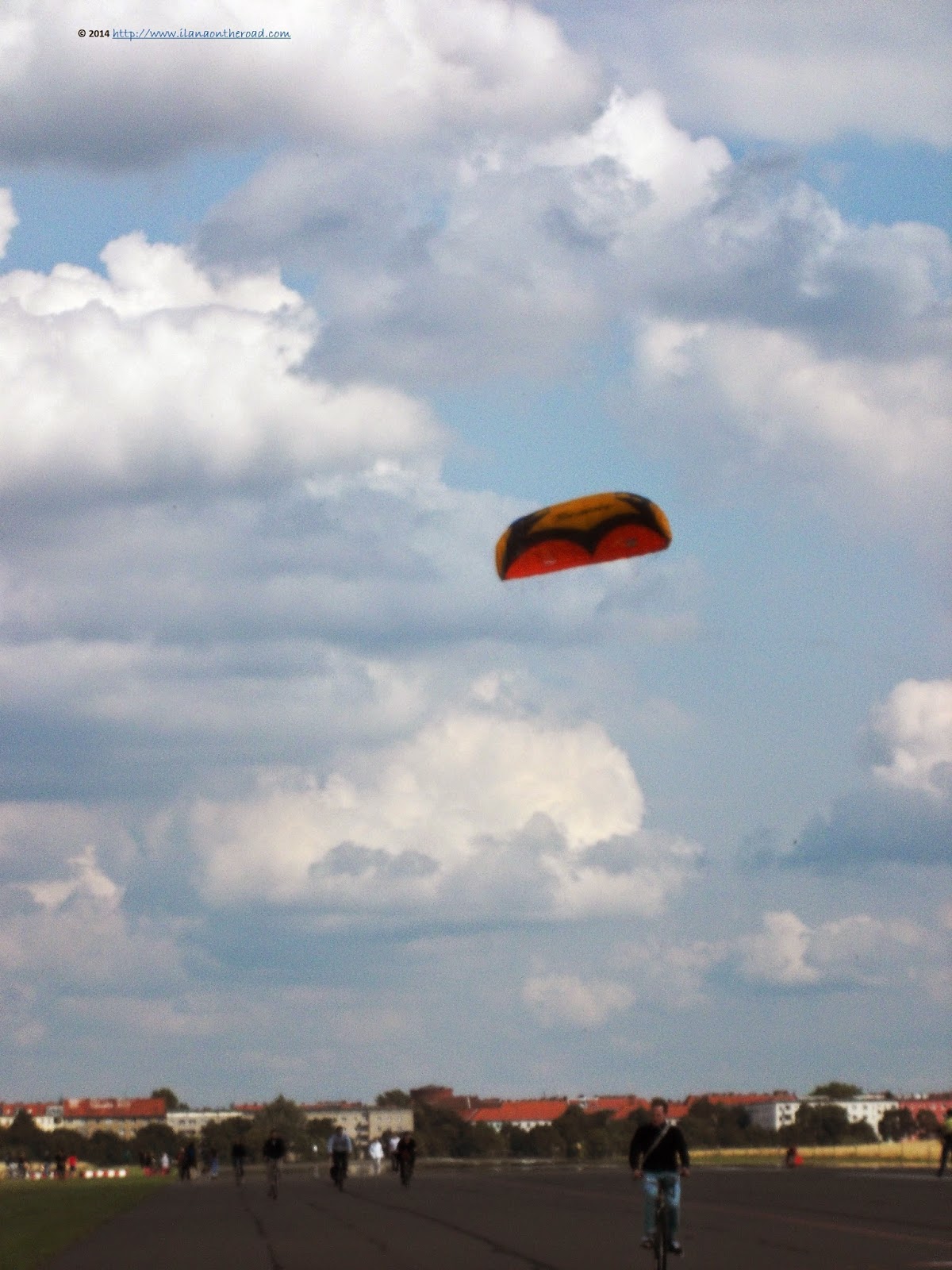
We headed to Tempelhof with a very clear aim, besides the journalistic curiosity to revisit a famous place covered in the media of then last months: flying our kite. Although we had a very simple less than 1 Euro worth eagle kite, when arrived in a properly windy area, we were as proud to admire ours high in the sky as the other professional kite runners developing expensive professional tools. 
When I felt a bit bored by kites and grass and loads of history, I rented a bike for one hour- for 6 Euro - and toured the former airport lanes more than once for some speed touring of the location. In some places it was quite easy to speed up in some I should use some extra energy, as I was facing some windy air counter strength. 
Besides the bikes, other renting options available were carting, unicycles, tricycles, with prices starting from 2 Euro the hour. 
I am neither an economist nor an urban planner, and have no idea what the real estate projections for the area were. As a simple visitor from time to time and sentimental kite runner, I can only enjoy my time there, in the most selfish possible way. Especially in the summer and spring, it can be a good location for spending some free family time in the middle of the nature, eating the food from your basket and chilling out for an indefinite non-payable amount of hours. 

Montag, 1. September 2014

Foodie Berlin: Crêpes Suzette

One year after my beautiful trip to Nantes, I am still looking for the original taste of the salted caramel. I know that it's only my fault for not taking the first plane back to France, but I promise to repent looking for the best places to have an original 'crepe' in Berlin. While inspecting Pappellallee back and forth a couple of weeks ago, I discovered the Crepes Suzette, but they were on vacation at the time. One week after, I was back to check how much Bretagne I can find in each crepe. 
The first encounter was sweeter than expected: we chose our dishes from TinTin books, to whose pages were added menus with various sweet and salty options. There are special lunch menus and galettes du jour - made according to the high standards of the French art, of course. 
There are a lot of places outside, but for the time being, taking a seat indoors is wise - giving the weather forecasts. The interior looks clean, simple, with wooden table and a lot of publications to browse till the crepes are ready. 
As for me, I preferred to find out more about the history of the 'crepes Suzettes'. As any serious invention, they were created by accident, in Monte Carlo, by the 14-year old Henri Carpentier in 1895. While preparing the pancakes fro the Prince of Wales, the future King Edward of England, the alcohol from the sauce where the premade pancakes needed to be soaked - together with orange peel and sugar - caught fire. Out of time, he served those pancakes to the distinguished guests that were delighted. Initially called 'Crepes Princesse', the name was changed to Suzette, in the memory of the young daughter of the Prince - some might say she was rather the lover. Regardless of the circumstances, the crêpes made their entry into the culinary history and are there to stay. 
Now, that I've learned something new for the day, it was about time to reward myself with something tasty. The service was fast and friendly, with French and German joyous conversations. My creme salée Caramel Bretagne pancake was big, with a fine texture - I was able to feel the good combination between eggs and flour - adorned with the very sweet Caramel sauce. The salt was moderated in the advantage of the sugarly layer. One can also add some icecream to the dish, which can be a good option for the hot summer days.
As for me, I was happy to have back into my palate the sweet Nantes memories. Given also the pleasant service, I might be very tempted to return for a new culinary experience in the near future.

Dienstag, 26. August 2014

Düppel, the Medieval village in West Berlin

Long before I was ready to land to Berlin, a historian friend of mine strongly recommended me to include Museum Düppel on the to-do-list of my first week of discovery of the city. As the museum is open only from April to October and the program is limited to a couple of hours the week, plus the other contemporary attractions calling loud my name in other parts of the city, it took me 6 years to finally visit it. The last Sunday, we took the bus no. 115 from Fehrbelliner Platz and from the station Ludwigsfelde, we followed the arrows till the entrance.
The open air museum is situated in the middle of a forest in Steglitz-Zehlendorf on the site of a former medieval settlement discovered during archaeological excavations at the end of the 1960s. Long before that, in 1940, some fragments of pottery were localized around 1200 CE. Progressively, the area was turned into a little village aimed to recreate the habits and ambiance of what the historians imagined was the quiet life in the middle ages. For instance, the visitors are tempted with jars of fresh honey.
Most products are made on the site, as it is the case not only with the honey, but also with some herbs - for both tea and cooking - or various types of vinegar produced from the gardens cultivated on small slots of land. The three-field system rotation of crops, that it's said to contribute significantly to the agricultural development of Europe, is put into practice on a daily basis in Düppel.
Women in long grey-white costumes - the fashion of the time - are introducing the visitors to the traditional customs practised then: pottery, woodworking, spinning, weaving or tar production.
As in any respectable medieval household, there are also some animals around, enjoying their green grass and the admiration of the children. The museum succeeded to keep some native medieval breed of sheep, such as the 'Skudde' or a local breed of free-range pig. Pony riding is also possible and guided tours are offering details about the breeding techniques. 
Our visit coincided with the summer festival - the last Sunday before the schools start - and it was even more crowded, with many children running wild in the woods. Tables with 'home made' foods were waiting to refuel them with new portions of energy. Traditional German Flammkuchen were made directly in some brick oven. Regularly, soups made following medieval recipes are served from big black pots.
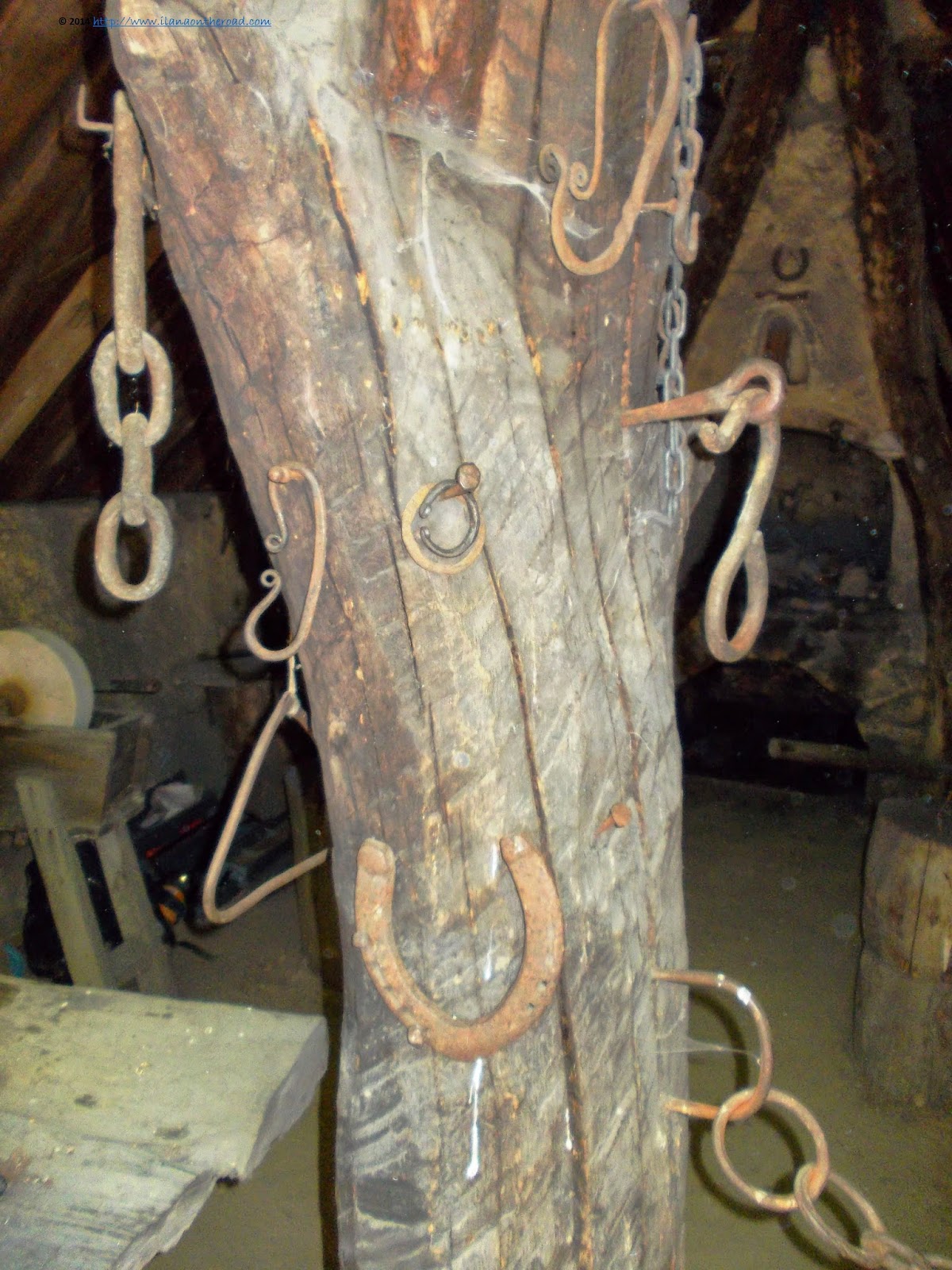
In another corner of the huge park, a live blacksmithing demonstration. The team, among them a woman, were doing their work slowly without being bothered by the curious eyes some of them probably ready to do their own experiment. For someone with two clumsy hands, it looked a bit dangerous so tried to stay away. 
More than the live experiments and the food, I loved the idea of reconstructing old habitation spaces. My expectations were a big high initially, considering similar village museum I visited in Europe, but here there is no geographical representation of various German areas, the architectural research being focused on reconstructing the village as it used to be in this specific part of Berlin.
Once you enter the little house, one might be bothered by the lack of light and the cramped space. Sometimes, we forget about how much did it take to acquire the comfort of electric illumination and of high-ceiling condos. 
 If you ever had the chance to learn weaving, here is the place to try to remember your lessons. 
 Otherwise, riding a little wooden horse is an experience you will never forget or need to learn for too long.
Thankful for the sun, I took as much time as possible to explore the neighbourhood house by house, not too creative in trying to imagine how the daily life used to be those times. This is how I ended up studying contemporary history, probably.
The merit of this little village is the punctilious concern to recreate a comprehensive landscape of the old village. The work started in the 1970s and lasted a couple of good decades till the final inauguration. For the construction, ancient techniques were used.
The huge open air spaces are offering enough vantage points to relax, with or without a book, and get immersed into the ambiance. 
Such a generous space is perfect for children that can jump freely around, playing with various old games. As for me, I tried more than once to walk on stilts without any chance of success.
The beginning of early autumn is the best time to be around, at least for the colours of the fruits - that the visitors are not allowed to pick up. Due to its historical features, the children under 14 are not allowed to visit unattended and climbing the old buildings, as tempting as it sounds, is strictly forbidden. 
Under the guidance of their teachers and parents, the children have a lot to learn about the old - not necessarily good - times. A visit to a museum or a live presentation, or even the experience of a pottery workshop can be more valuable than long boring hours in the classroom. 
This goes for the old art of cooking too, as old cooking books from the 14th century are available on sale for those interested for a historical menu.
Even though a bit too late, I am happy I finally made it to this medieval village. Till October, I still have time for a new visit, maybe to watch life some chivalry confrontations.

Donnerstag, 21. August 2014

Foodie Berlin: Mon Plaisir Chocolaterie

After one year and a little bit of intensive searches for the best macarons in Berlin, last week I felt closer than ever to the end of the challenge. At Mon Plaisir Chocolaterie, on Pappelallee 9, macarons are served in different colours and flavours. They are blue, as a violet and blackcurrant - sweet, fresh and fondant - or honey beige, with some traces of sesame seeds - Yuzu, the halwa flavoured embellished with a fine drop of chocolate - or they have small points of green, the traces of mint and the taste of summer fresh chocolate. 
My choice was minimal, the sweet treats after a long lunch, out of an insensitive richness of flavours and colours. I wanted a good outdoors spot at one of the wooden garden tables, keeping at bay the many sweet temptations calling my name indoors: French chocolate, biscuits, cakes and, again, many many macarons. The coffee was normal, not necessarily strong, but my mind was already set in admiration for every bit of the fine chocolate of the macarons.   
With so much French being spoken around me - the maitre patissier is, you guessed, French - and the big generous box of macarons, you know where you can find me for the rest of the summer. 

Montag, 18. August 2014

Foodie Berlin: Lon Men's Noodle House

When all the foodie options fail or when I am lazy enough to refuse to read any of the many cookbooks resting on the shelves, Kanstrasse is always the best alternative for an affordable tasty dinner or lunch. After a couple of hours of walking in the woods near Teufelsee, we ended up wandering on the above mentioned street for some special yet healthy lunch. Was a kind of sad to notice that I checked almost all the pubs and restaurants on both sides of the streets. Except one: Lon Men's Noodle House, a Taiwanese noodle parlour situated on no. 33. 
Although busy, we succeeded to find some free places outside, courageous enough to cope with the invasion of wasps. There were a couple of places inside too, small traditional tables crowded near pictures from Taiwan or the owner near various personalities that visited the eatery, among which the former chancellor Helmut Kohl. The owners did not invest too much in the interior design, but at least the food is served in Asian-looking bowls which brings a little note of authenticity to the experience. 
I ordered some peanut and sesame noodles, brought relatively fast. The noodles were different of what I tasted before: smooth, consistent, kind of silky, with a special consistency probably given by the eggs. The veggies - fine slices of carrots, cucumber and salad - added a lot of freshness that diminished in a welcoming way the satiety of the peanut sauce. As for the sesame, I did not feel it too much, maybe I should give a new try to this dish for a better understanding of the recipe. 
And even not for the dish, I am still decided to give a new try to this place, just because I am sure it will inspire me for more Asian trips soon!

Sonntag, 17. August 2014

Exploring Teufelsee

After spending one month far away from Berlin, I tried to get in touch again intensively with the city in the last days. Except the weather - an autumn cocktail of rain, grey clouds and some happy hours of sun - I must recognize that I missed the city and in the last week I tried to visit as many old beloved places as possible, as well as checking new destinations. Since the early spring, my friends recommended me Teufelsee as a quiet destination for slow hiking. Today, I finally made it there. From the S-Bahn Grunewald, I passed on the other side of the train passage, near terraces and open air restaurants. Some of them were renting bikes for 12 Euro the day, a tempting offer given the hike concentration of bikes in the area. However, I resisted the temptation and preferred the slow walking around. 
Although there is not a marked road, is almost impossible to get lost. Especially today, it was plenty of bikes, Nordic walkers, families with children, joggers and a lot of dogs and their owners. Happily enough, the forest is big enough for all the people from Berlin looking for a secluded green paradise. 
From time to time, there were big billboards explaining the visitors what they can expect in terms of flora and fauna, but unfortunately I did not spot anything special.
From afar, the mysterious Teufelsberg listening station, the former CIA center in West Berlin, was overseeing the area. 
Suddenly, the secluded beach I was told about appeared. True is that it was not that secluded, and there were a lot of people around chilling out or having lunch on the fine sand dune, but the presence was spectacular.  
The traces of conifers on the sand brought an air of mystery to the place, while announcing the inevitable autumn. 
 We kept walking near the fallen trees and serious joggers, looking for an animal farm I was told about. 
But we only found the lake, with children training to swim over a canoe. Their enthusiastic noises were contagious breaking up from time to time the majestic silence of the area. Here  is a short live video. 
The area was crowded, so we preferred to keep walking and walking, looking for more fresh air and even more hiking. Although I was well trained, after intensive hiking in medium to difficult mountains, I enjoyed the slow motion. Good sport shoes are recommended for a successful experience. 
I suppose the journey can be done all round the year, but this time of the year is perfect for the good temperature and the beautiful green scenery. 
Wild colourful fruits were sparkling from time to time the green monotony. I tried to spot some special animal traces in the fresh mud, but could not get anything special. Better for me, as during my last hiking in the Carpathians, I was showed some delicate bear trace and was not sure how I should react if finally meeting the furry one.  
On the ground, wild mushrooms were ready for some photon opportunities. I felt sad to leave the Teufelsee, thinking about the coming cold weather and the limited experiences of hiking. However, with so many green areas and forests in and around Berlin, I should try to repeat the experience at least twice the week in the coming month. Not only keeps me fit, but gives me a certain feeling of well being and mental wellness.